How AI Resume Screening Helps HR Hire Faster Without Bias
The Problem: Hiring is Slow; It’s Hard to Stay Fair
For most HR teams, resume screening is where hiring slows down.
Applications arrive quickly, often in large numbers. Recruiters are expected to review each profile carefully, shortlist the best candidates, and move fast enough to keep hiring managers and candidates engaged.
In reality, screening takes time.
Fatigue sets in.
Decisions start depending on who reviews the resume and when.
This is typically the stage where HR teams start questioning whether their screening process is both fast and fair and whether it can realistically achieve both at the same time. That’s often when solutions like Jobdrive AI start to come into consideration.
The Cost of Ignoring Speed and Bias is Screening
Many teams accept slow screening as unavoidable. Bias, when it appears, is often unintentional and difficult to measure.
Over time, the cost becomes clear:
- Strong candidates drop out due to delayed responses
- Hiring managers grow frustrated with slow pipelines
- Recruiters feel pressure to “move faster” without better tools
- Inconsistencies appear across shortlists.
Bias doesn’t always show up as a wrong decision. More often, it shows up as missed opportunities for candidates who were never seriously considered.
Without a structured screening approach, these problems repeat with every role. This is typically when HR teams start looking for systems that can bring consistency without removing human oversight.
Modern Hiring Expects Both Speed and Fairness
Hiring expectations have changed.
Today, human resource teams are expected to
- Shortlist candidates quickly.
- Apply consistent evaluation criteria.
- Reduce bias during the early screening process.
- Maintain complete transparency when making hiring decisions.
Candidates anticipate quicker feedback from HR.
Leadership expects hiring decisions to be data-driven and justifiable.
Meeting these expectations manually becomes more difficult as the volume of applications increases. AI resume screening is increasingly being used to assist recruiters rather than replace them.
Where Manual Resume Screening Falls Short
Manual screening relies heavily on time, focus, and individual judgment.
At scale, common issues appear:
- Resumes reviewed later in the day receive less attention
- Familiar backgrounds are prioritized unconsciously
- Keyword-heavy resumes are favored over relevant but conventional profiles
- Screening criteria shift between reviewers
None of this happens intentionally.
It happens because humans are working under pressure.
At this stage of the hiring workflow, tools like Jobdrive AI are often introduced to handle the first screening layer, allowing recruiters to focus on evaluation rather than volume.
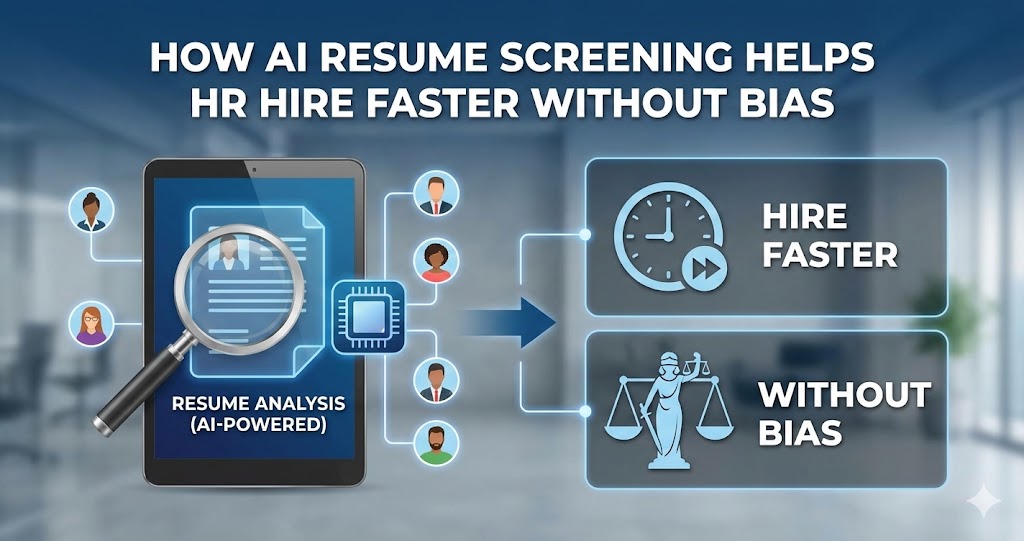
How AI Resume Screening Helps HR Hire Faster Without Bias
AI resume screening adds structure to the earliest stage of the hiring process.
It helps by
- Reviewing large volumes of resumes quickly.
- Applying the same screening criteria to each profile.
- Reducing the effect of fatigue and time pressure
- Highlighting relevant candidates consistently.
Jobdrive AI supports HR teams by organizing and screening resumes based on role-specific requirements while keeping final decision-making with recruiters and hiring managers.
The goal isn’t to remove human judgment.
It’s to ensure that judgment is applied where it matters most.
See How Jobdrive AI Supports Fair and Fast Hiring
Speed and fairness do not have to be opposing forces.
If your hiring process feels slow, inconsistent, or hard to scale, it may be time to take a closer look at the way resume screening is done.
👉 Book a personalized demo of Jobdrive AI
👉 Schedule a 1:1 walkthrough based on your problems with hiring candidates
See how AI resume screening can help your team hire faster without compromising fairness.
