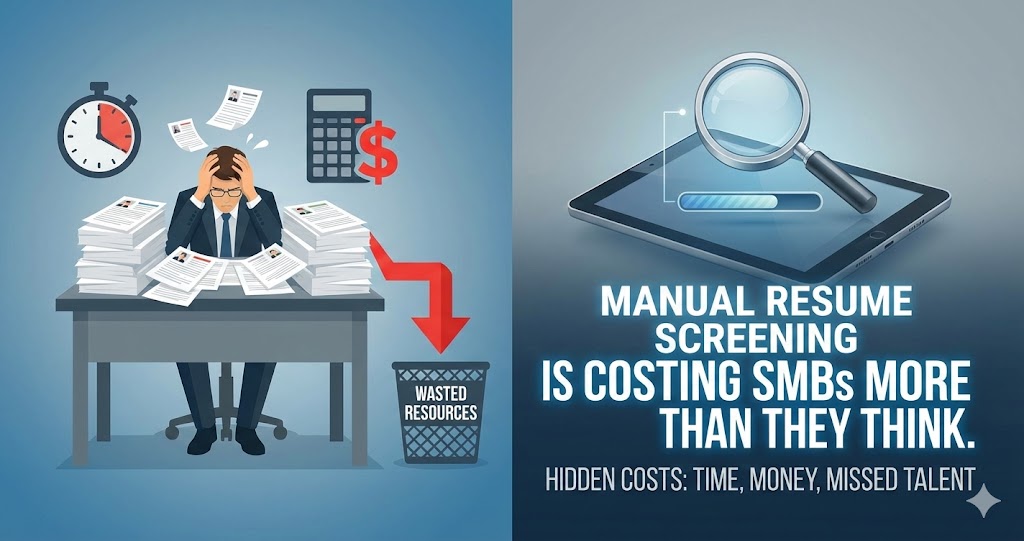
Manual Resume Screening Is Costing SMBs More Than They Think
The Problem: Manual Resume Screening Still Dominates SMB Hiring
For most small and mid-sized businesses, hiring starts manually and stays that way for a long time.
Resumes come through email or job portals. Someone downloads them. Someone scans them. Someone tries to shortlist the best profiles while juggling other responsibilities.
At first, this doesn’t feel like a problem. It feels normal.
But as application volume increases, manual resume screening slowly takes over the hiring process. Recruiters, or sometimes the business owners themselves, spend hours reviewing profiles instead of focusing on interviews or decision-making.
This is often the stage where SMBs start noticing that hiring feels heavier than it should. Tools like Jobdrive AI are usually explored when businesses realize they need structure without adding complexity.
The Cost of Ignoring Manual Hiring Inefficiencies
Manual screening rarely fails loudly.
It fails quietly.
For SMBs, the hidden cost of the manual hiring process is reflected in the following ways that are not always immediately apparent:
- Delayed shortlisting: This implies that the best candidates have already moved on
- Teams remain understaffed for a longer period than intended
- Recruitment is based on hurried resume screenings
- The more time spent screening, the less time spent engaging candidates
The cost of loss that is most expensive is invisible.
Applicants who did not fit the keywords exactly are usually overlooked, and no one even knows that they existed.
Without structured screening, these inefficiencies repeat with every role. This is typically when SMBs realize that manual hiring is not just slow, it’s costly.
Modern Hiring Expectations Apply to SMBs Too
Even smaller businesses are expected to hire like structured organizations now.
Candidates expect:
- Faster responses
- Fair shortlisting
- Consistency in screening
Business owners expect:
- Predictable timelines
- Better hiring accuracy
- Less manual workload
Meeting these expectations through manual resume screening becomes difficult as hiring volume grows. This is why many SMBs begin looking at AI-assisted hiring platforms to support their process.
Where Manual Resume Screening Breaks Down
Manual hiring works when there are fewer resumes.
It struggles as numbers grow.
These include:
- Recruiters skimming instead of evaluating
- Bias is creeping in due to fatigue
- Keyword filtering is missing relevant profiles
- No consistent screening criteria
The problem is not the ability of the recruiter.
It’s that manual resume screening doesn’t scale well.
At this stage, SMBs are likely to employ structured methods like Jobdrive AI to handle the heavy resume screening layer while still keeping human-driven hiring decisions.
How AI Reduces the Hidden Cost of Manual Hiring
Resume screening using artificial intelligence brings some order into the chaos that exists when resumes are screened manually
It helps SMBs in:
- Analysing a large number of resumes within a short period
- Applying consistent evaluation logic.
- Pointing out relevant profiles that might otherwise be missed
- Reducing bias from fatigue and overload
Jobdrive AI helps in the recruitment process of SMBs by taking care of the screening of resumes in an efficient manner so that business owners can focus on the interviews and final selection.
The aim is not automation for the sake of speed. It’s better to hire with less waste.
Ready to Rethink Resume Screening?
If hiring is taking longer than expected or strong candidates seem harder to find, the issue may not be talent; it may be the process.
Manual resume screening creates hidden costs that grow with every hire.
👉 Book a personalised demo of Jobdrive AI
👉 Schedule a 1:1 walkthrough tailored for SMB hiring
See how structured AI screening can help you hire faster, more fairly, and with fewer missed opportunities.
