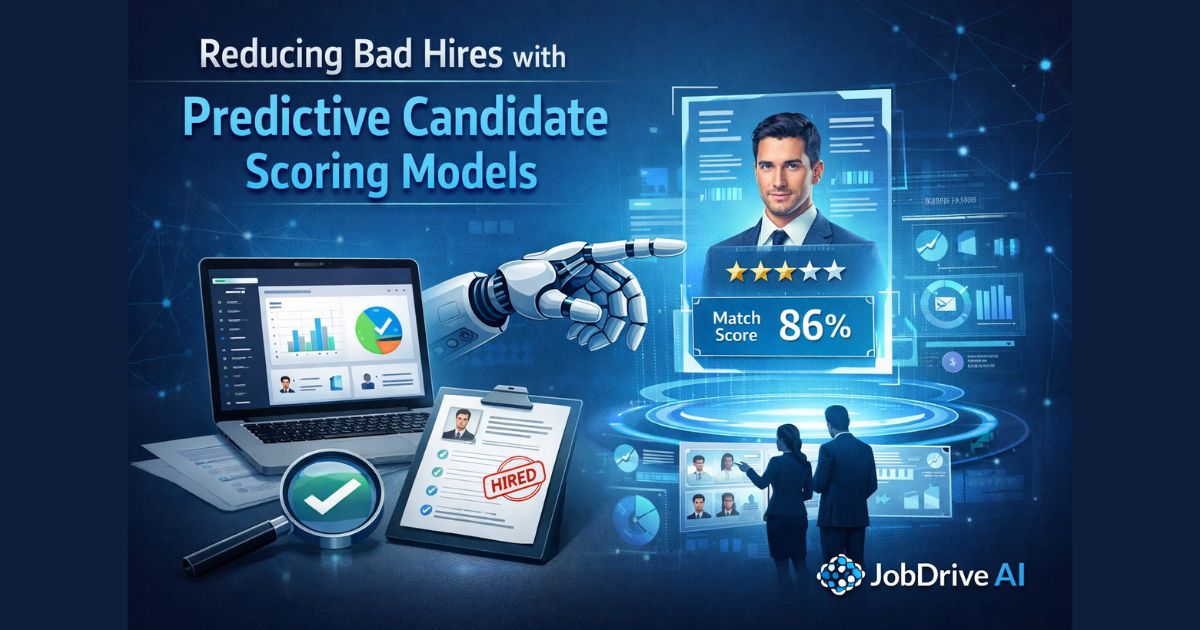
Reducing Bad Hires with Predictive Candidate Scoring Models
Every business is aware of the price of a poor hire. Thousands of dollars – as well as months of progress – can be lost due to decreased productivity, lost time, low morale, and the cost of restarting the hiring cycle. Traditional hiring methods rely heavily on human judgment and resume reviews, which often miss deeper indicators of performance, behavior, and role fit.
Because of this, one of the most beneficial developments in hiring technology is predictive candidate scoring. Companies now use AI-driven scoring models to evaluate candidates objectively and determine who is most likely to succeed, rather than depending only on intuition.
What Is Predictive Candidate Scoring?
AI and machine learning are used in predictive candidate scoring to evaluate candidate data and produce a score that indicates a candidate’s suitability for the position.
These scores are based on factors such as:
- skills and competency alignment
- experience relevance
- communication patterns
- problem-solving ability
- performance indicators
- behavioral traits
- historical hiring outcomes
Long before the interview phase, this provides recruiters with a data-backed snapshot of a candidate’s potential.
Why Predictive Scoring Reduces Bad Hires?
1. It Identifies High Performers Early
AI models pick up on past performance trends and successful hires.
Candidates with comparable characteristics, skill sets, or work habits score higher, providing recruiters with early insight into who should be given priority.
2. It Minimizes Bias
Unconscious bias can affect people, but predictive scoring only considers information that is relevant to the job.
This creates:
- consistent evaluations
- fairer comparisons
- more diverse candidate pools
Better hiring decisions begin with objective scoring – not assumptions.
3. It Provides a More Complete Candidate View
A candidate’s actual potential cannot be determined solely by their resume.
Predictive scoring looks at:
- personality indicators
- behavioral insights
- success likelihood
- learning adaptability
This 360° evaluation dramatically reduces hiring risks.
4. It Speeds Up the Shortlisting Process
Recruiters don’t have to spend hours going through applications because they can see the best candidates right away.
This leads to:
- faster hiring cycles
- better candidate engagement
- fewer drop-offs
Speed is a competitive advantage in today’s job market.
5. It Improves Long-Term Hiring Outcomes
Teams encounter the following when hiring decisions are made using data rather than conjecture:
- reduced turnover
- improved cultural congruence
- improved worker performance
- increased output as a team
Companies can invest in individuals who will succeed, not just those who do well in interviews, by using predictive scoring.
Conclusion: How Jobdrive AI Assists You in Preventing Poor Hiring
Jobdrive AI employs sophisticated predictive candidate scoring to assist companies in confidently identifying top talent. Jobdrive AI provides precise scoring models that significantly lower hiring risks by examining skills, experience, behavior patterns, and performance indicators.
Recruiters spend more time interacting with the best candidates and less time screening thanks to automated ranking, intelligent skill matching, and real-time insights. Additionally, businesses can access powerful AI-driven hiring tools without increasing their recruitment budget because Jobdrive AI is currently free.
Jobdrive AI helps businesses avoid expensive errors and create stronger teams by making hiring smarter, faster, and far more dependable.
