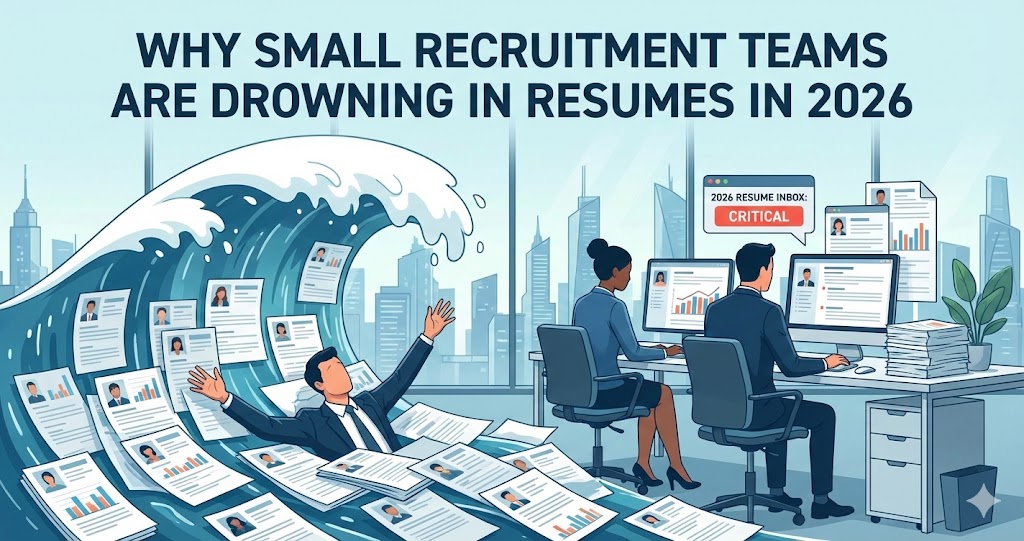
Why Small Recruitment Teams Are Drowning in Resumes in 2026
Small recruitment teams are facing unrelenting floods of resumes in 2026, creating bottlenecks, inefficiencies, and stress across hiring teams everywhere. Resume floods may seem like a good problem to have, but the reality is far more complex. Hiring teams are now battling dozens of operational stressors brought on by resume avalanches.
This blog will explain the growing resume overload problem and explores how modern intelligent tools, especially resume screening automation and Jobdrive’s technology- can transform resume overload into hiring ease.
The Resume Overload Problem: What’s Happening in 2026
1. Explosion of Applicants
Over the last decade, the number of job seekers has grown exponentially. Several major global workforce shifts have contributed to this surge.
Global Workforce Expansion
Remote work now allows job postings to attract candidates from across the world. A single job listing can receive applications from multiple countries and time zones within hours.
Growth of the Gig and Freelance Economy
Many professionals now pursue full-time employment while simultaneously seeking freelance or contract work. This increases application volumes significantly.
Job Platforms with Easy Alerts
Job alerts and one-click applications have simplified the process. Candidates now apply to more roles than ever before, often with minimal filtering.
The demand for recruitment agencies and hiring teams has grown dramatically. A role that received a couple dozen applications in 2015 may now attract hundreds or even thousands — especially in tech, healthcare, marketing, and customer service.
Why Smaller Teams Are Affected More
Not every company experiences resume overload in the same way. Larger organizations often have dedicated recruiting operations, sourcing teams, and advanced applicant tracking systems (ATS). Smaller companies, however, have fewer resources, which makes the process more difficult to manage.
Here’s how small recruitment teams struggle the most:
1. Limited Staffing
Small recruitment teams often consist of just one to three people managing entire hiring cycles across multiple roles. They simply do not have the capacity to review every CV individually.
2. Outdated Systems
Many smaller teams rely on legacy ATS platforms, spreadsheets, and job boards. These systems lack modern sorting, filtering, and intelligent resume screening automation capabilities.
3. Manual Resume Review
Recruiters must manually open and read resumes one by one. Basic screening tools rarely speed up the process. The result is a repetitive, mind-numbing task that drains productivity and focus.
4. Slowed Hiring Pipelines
Hiring managers expect quick turnaround times. When recruiters are buried in resumes, response times slow, pipelines stall, and positions remain unfilled longer than necessary.
The Real Impact of Resume Overload
The consequences of resume overload go far beyond simple irritation. Recruitment outcomes and overall business performance suffer significantly.
1. Greater Candidate Discontent
When recruiters are overwhelmed:
- Response times increase
- Communication becomes slower
- Candidates accept other offers
A negative hiring experience can damage an employer’s brand long-term.
2. Disappearing Talent
Qualified candidates may be overlooked entirely. When application volumes are excessive, strong resumes can easily be missed. This leads to the false assumption that quality talent is unavailable.
3. Recruiter Fatigue and Burnout
Constant manual resume screening leads to exhaustion. Stress levels rise, job satisfaction decreases, and burnout becomes more common.
4. Increased Cost of Hire
Slow screening processes extend the recruitment cycle. Longer hiring timelines increase onboarding delays and overall recruitment costs. In competitive markets, slow hiring means losing candidates to faster-moving competitors.
5. Cognitive Fatigue and Poor Decision-Making
When recruiters are mentally exhausted, decision quality declines. Bias, oversight, and inconsistent judgment become more likely. Fatigue directly affects hiring accuracy.
What’s Wrong with Traditional Applicant Tracking Systems?
Many companies believe that having an ATS solves the resume overload problem. While ATS platforms help store resumes, they often fall short for small recruitment teams.
Common issues include:
- ATS platforms capture resumes but do not truly evaluate candidate fit.
- Many lack semantic search or AI-powered analysis.
- Keyword matching dominates results, often ignoring real-world experience.
- Manual system adjustments are required.
- Databases become cluttered and difficult to manage.
In short, traditional systems organize resumes — but they do not significantly reduce workload. They lack advanced resume screening automation that actively decreases screening time.
Intelligent Automation: A Smarter Way Forward
Modern intelligent technology offers a more advanced solution. Rather than replacing recruiters, automation enhances their ability to focus on high-value work.
The purpose of resume screening automation is to eliminate repetitive tasks while preserving human decision-making.
Here’s how intelligent automation helps:
1. Automated Resume Parsing
Instead of manually opening and reading each document, automation extracts key data such as skills, experience, certifications, and education instantly.
2. AI-Based Candidate Screening
Advanced AI models evaluate resumes against job criteria, scoring candidates based on overall fit.
3. Semantic Matching
Modern systems understand meaning, not just keywords. For example, they recognize that “frontend engineer” and “UI developer” represent similar roles even if exact words differ.
4. Automated Prioritization
Rather than reviewing 1,000 resumes, recruiters receive a ranked shortlist of top matches first.
5. Chatbots and Automated Outreach
Automation assists with confirmations, screening questions, and interview scheduling, reducing administrative burden.
By implementing resume screening automation, small teams can dramatically improve efficiency without sacrificing hiring quality.
Challenges to Automation Adoption
While automation offers clear benefits, adoption is not always simple.
1. Budget Constraints
Many advanced tools are priced for enterprise organizations, making them difficult for small teams to afford.
2. Integration Barriers
Legacy systems may not integrate smoothly with new automation platforms.
3. Change Resistance
Recruiters may worry that automation reduces their role or removes the human element from hiring.
4. Data Privacy Requirements
Automation systems must comply with data protection regulations, adding complexity to implementation.
Despite these concerns, the benefits of resume screening automation often outweigh the challenges when implemented properly.
Jobdrive: The Automation Solution for Resume Overload
To succeed in 2026 and beyond, small recruitment teams need tools that are powerful, cost-efficient, and recruiter-focused.
Jobdrive provides exactly that.
What Jobdrive Does
Jobdrive is a modern hiring automation solution designed to combat resume overload through intelligent resume screening automation. It helps teams by:
- Smartly parsing and scoring resumes
- Ranking candidates by best fit
- Automating outreach and screening workflows
- Integrating seamlessly with existing ATS and HR systems
- Delivering actionable insights, not just stored data
What Makes Jobdrive Different for Small Teams
Unlike traditional systems that simply store resumes, Jobdrive actively reduces screening workload. Recruiters are able to:
- Review top candidates first
- Focus on personalized communication
- Minimize time-to-hire
- Provide hiring managers with stronger shortlists
Real Impact
Small recruitment teams using Jobdrive report:
- Less time spent screening resumes
- Faster candidate engagement
- Greater recruiter satisfaction
- More consistent hiring outcomes
Book a consultation with Jobdrive today and explore a tailored automation strategy built for small recruitment teams. Visit the official website now!
Summing Up
The resume overload challenge will only intensify in 2026. What once felt manageable has now become a serious operational bottleneck affecting candidate experience, recruiter morale, and hiring outcomes.
Application volumes continue to grow due to globalization, remote opportunities, and easy-access job platforms. Small recruitment teams lack the staffing and systems to handle the surge effectively. Manual processes lead to stress, delays, and missed talent — which can severely impact business performance.
However, the right technology changes everything.
The future of recruitment is not about handling fewer resumes. It is about handling them smarter.
When small recruitment teams adopt the right automation strategy, resume overload transforms from a burden into a competitive advantage.
